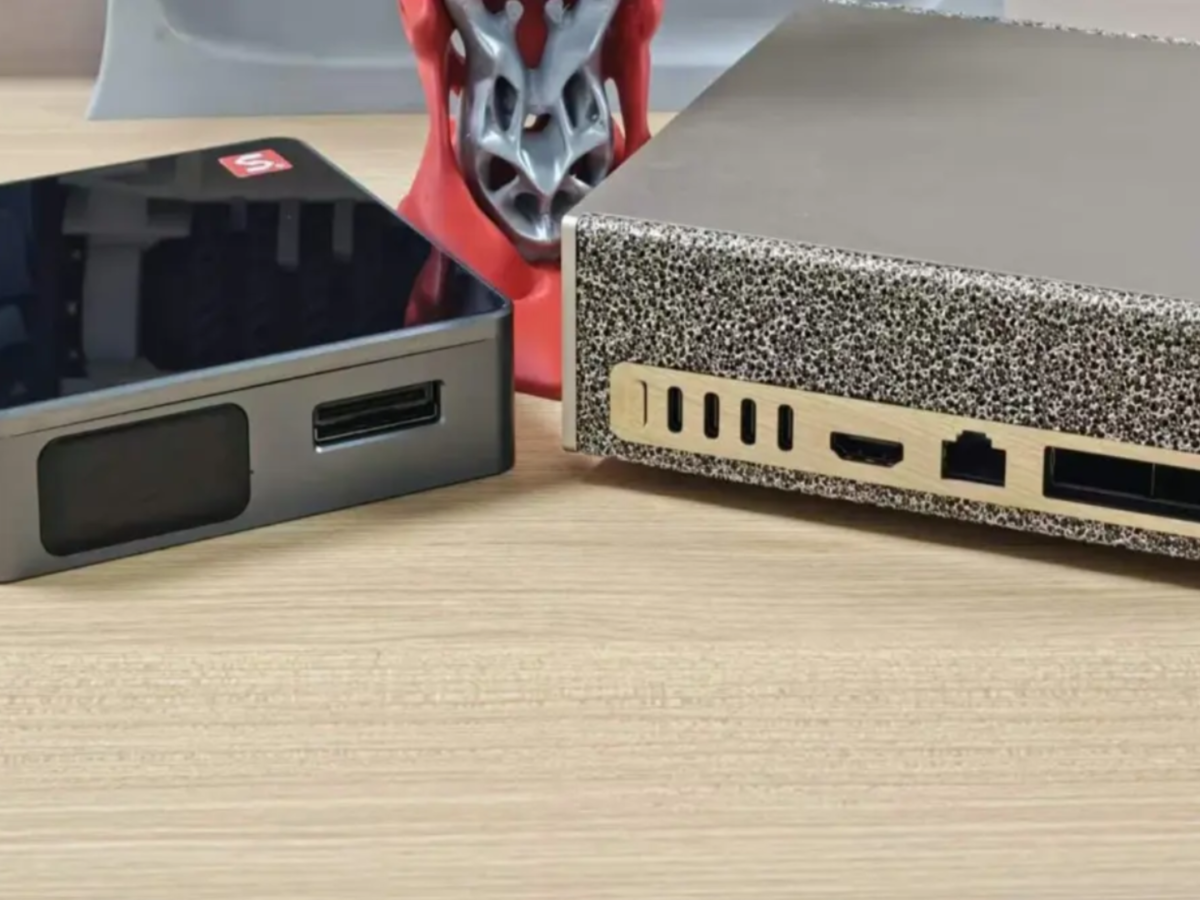
Plucky Chinese startup claims to beat Nvidia DGX Spark, Mac Mini on Qwen — says its ‘256 TOPS beats 1000 TOPS in prefill’, running 16-core Cortex-A55 SoC on 40w
Sipeed claims its 256 TOPS mini PC can outperform Nvidia on Qwen The 128GB Sipeed MaixStation costs less than Nvidia’s reported $6,949 DGX Spark Nvidia advertises 1,000 sparse FP4 TOPS, while Sipeed emphasizes practical inference performance Chinese electronics manufacturer Sipeed has claimed its upcoming MaixStation AI computer can outperform Nvidia’s DGX Spark in certain Qwen workloads despite considerably lower advertised computing performance. Powered by Axera’s AX8860P processor, the compact machine combines 16 Arm Cortex-A55 cores with AI acceleration reaching 256 TOPS and typical consumption of 40W. Sipeed is also challenging Apple’s Mac Mini in its comparisons, although the available benchmark figures primarily concern Nvidia’s system rather than Apple’s hardware. MaixStation challenges Nvidia’s performance advantage Sipeed’s published Qwen results indicate that its 128GB configuration slightly exceeds the DGX Spark’s performance, with further software improvements expected to increase throughput. The company attributes this outcome partly to differences in how advertised computing capacity translates into actual performance when processing large language models. Nvidia advertises 1,000 TOPS using sparse FP4 calculations, whereas Sipeed argues that practical workloads cannot fully exploit this theoretical computing capability. Although Nvidia’s dense FP4 performance approaches 500 TOPS theoretically, Sipeed maintains that its architecture uses available processing resources more efficiently during prefill. Both machines offer 273GB/s memory bandwidth, although Sipeed claims architectural optimizations allow its processor to sustain higher utilization during demanding inference operations. The comparisons were conducted with speculative decoding through multi-token prediction disabled, allowing the company to evaluate both systems under similar conditions…