GMKTec NucBox EVO-X1 Pro: 30-second review
Unless you specifically want an Intel-powered NUC, AMD-powered machines typically offer more power and features for less money. A classic example is the GMKtec EVO-X1 Pro AMD Ryzen AI 9 HX 470 AI Mini PC, which uses the latest Zen 5 architecture and Gorgon Point silicon to deliver plenty of processing power for a wide range of applications. Alongside its strong performance, it also supports ample memory, at least 16TB of storage, and an excellent port selection. This NUC offers USB4 and OCuLink ports, dual 2. 5GbE LAN ports, and triple (HDMI, DisplayPort and USB-C) screen outputs. GMKtec has a habit of refreshing a good idea before anyone finishes praising the last version, and the EVO X1 Pro is a prime example. It keeps the compact box that arrived with the original EVO X1 in late 2024. Inside, it swaps in AMD’s Ryzen AI 9 HX 470. It also moves to WiFi 7 and ships with 64GB of soldered memory. That raises two questions. Is the step up from the cheaper HX 370 model worth paying for? And does AMD’s platform still hold its ground now that Intel’s latest mobile chips are turning up in mini PCs? My review answers some of those questions, but it also poses a few I hadn’t considered. Based on some blistering performance, the GMKtec EVO-X1 Pro should be on any list of the best mini PCs, but are there more cost-effective options? (Image credit: Mark Pickavance) GMKTec NucBox EVO-X1 Pro: Price and availability
How much does it cost? From $1150
When is it out? Shipping now, but limited stock
Where can you get it? You can get it directly from GMKtec
GMKtec’s US store lists the EVO X1 Pro at $1,599. 99 for the 64GB and 1TB build. A 2TB option is also shown at $1,769. 99. At the time of writing, every configuration showed as sold out, and a banner warned that prices would rise soon. The page also shows a struck-through reference price of $2,299. 99. Treat that with a pinch of salt, because I’m confident that GMKtec has never sold any of these at that price. For those with less cash to splash, there is a single SKU of an HX370 model with 32GB of RAM and 1TB of storage for $1,149. 99. Please note that the memory on this machine is soldered, so you can’t get the HX370 model and add extra memory later. And the same is true of the HX470 SKUs, because while the platform can address up to 256 GB, you can’t add any more to the existing hardware. UK buyers have a separate GMKtec store, which doesn’t list this hardware yet. But based on dollar pricing, around £1250 for the review specification SKU seems believable. Warranty is listed as one year on the US store, although I think UK and EU retail laws would insist on longer warranty periods. The obvious competitor for this system is the MINISFORUM AI X1 Pro-470, which uses the same platform but a slightly different port and slot arrangement. For the same 64GB+1TB spec as the review hardware, MINISFORUM wants $1655, another $55 more than GMKtec. But the memory in the X1 Pro-470 is socketed, enabling it to be upgraded, with the caveat that the memory is running at a slightly slower speed. Because of the memory slots, MINISFORUM also offers this system barebones for only $727, if you have spare DDR5, M2 storage and a Windows Pro license. And it comes with a two-year warranty. The Beelink SER10 MAX AMD Ryzen AI 9 HX 470 is another socketed memory offering, but it’s $1699 for the 64GB+1TB model. The Geekom A9 Max 2026 Edition also has 32GB of RAM and 2TB of storage, with an asking price of $1519. It also has a socketed memory system and can be loaded up to 128GB. Among these mini systems, the EVO-X1’s asking price is roughly in line with the alternatives, but all of them use socketed memory, trading a little speed for greater flexibility. Value: 4 / 5
(Image credit: Mark Pickavance) GMKTec NucBox EVO-X1 Pro: Specs
Specifications Model:
EVO X1 Pro 64+1TB
CPU:
AMD Ryzen AI 9 HX 470, 12 cores, 24 threads, up to 5. 2GHz
Clock speeds:
2GHz base, up to 5. 2GHz turbo
Cache:
12 MB L2, 24 MB L3
NPU:
Up to 55 TOPS (Int8)
Platform AI totals:
Up to 86 TOPS across CPU, GPU and NPU
GPU:
Radeon 890M, 16 compute units, up to 3. 1GHz
Memory:
64GB onboard LPDDR5 at 6400MT/s, not upgradable
Primary storage:
1TB M. 2 2280 NVMe SSD (PCIe Gen4 x4)
Expansion storage:
1x M. 2 2280 NVMe PCIe 4. 0 x4
Wireless:
WiFi 7
Bluetooth:
Bluetooth 5. 4
Wired networking:
2x 2. 5GbE LAN, auto-negotiating down to 10Mbps
HDMI:
1x HDMI 2. 1, up to 8K at 60Hz
DisplayPort:
1x DP 2. 1, up to 8K at 60Hz
USB-C video:
USB4 up to 4K at 60Hz
Audio:
1x 3. 5mm CTIA Audio Jack
Ports front:
1x USB4 (40Gbps, PD 3. 0, Display Output)
1x OCuLink (PCIe4 x4)
2x USB 3. 2 Gen 2 (10Gbps
Ports rear:
2x USB 3. 2 Gen2 Type-A (10Gbps)
1x HDMI 2. 1 (Up to 8K@60Hz)
1x DisplayPort 2. 1 (Up to 8K@60Hz)
2x RJ45 2. 5G Ethernet
1x DC IN (5. 5 × 2. 5mm)
1x Kensington Security Lock
Dimensions:
107 x 111 x 63mm
Power input:
DC Input: 19V / 6. 32A, up to 120W
Cooling:
Vapour Chamber Dual-fan Cooling System
Dedicated System Fan with Integrated Lighting
Silent Mode: 35W
Balanced Mode: 54W
Performance Mode: Up to 65W Peak
Operating system:
Windows 11 Pro
Warranty:
1-Year Limited Warranty
GMKTec NucBox EVO-X1 Pro: Design
Metal enclosure from the original EVO-X1
Easy access
No memory upgrades
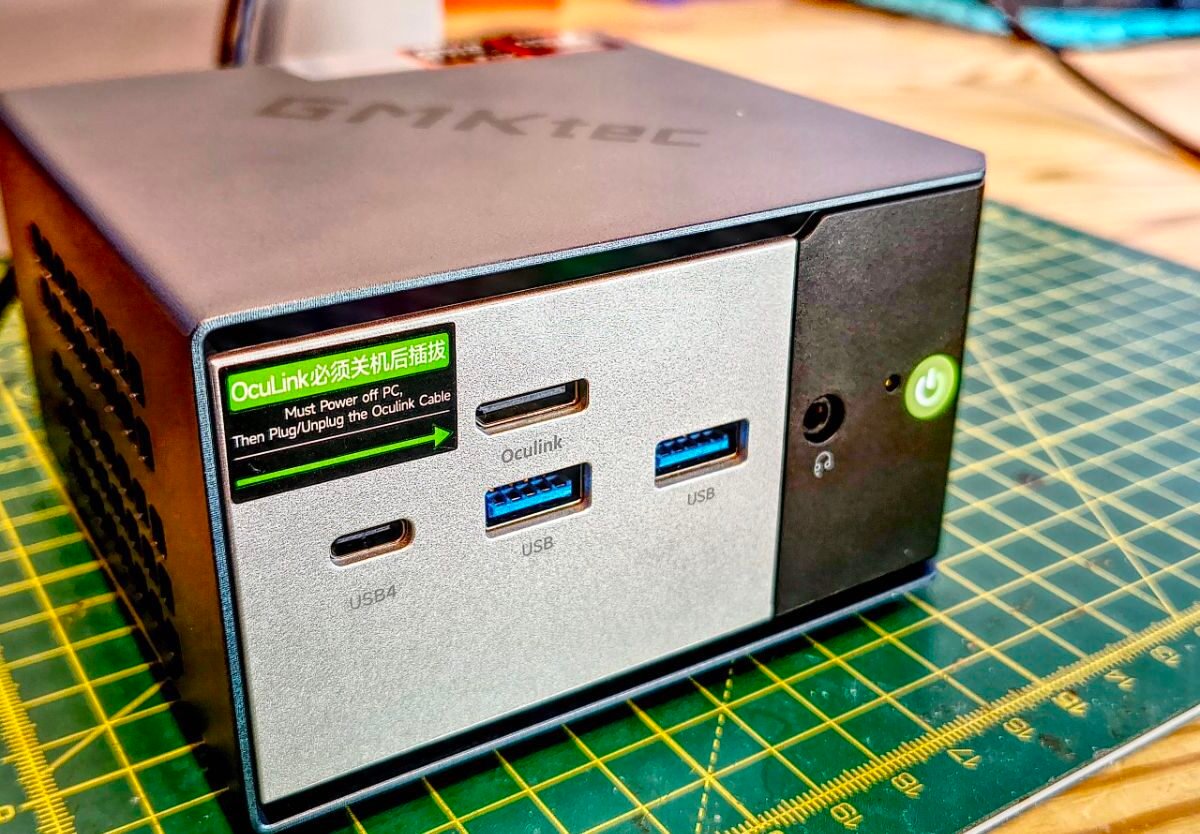
The chassis is unchanged from the original EVO X1. Dimensions are 110 by 107 by 63mm, and it weighs around 590g. Systems like this are often shorter vertically but wider in other directions, but this is a nice size for the desktop or for mounting on the rear of a monitor using the provided frame. GMKtec describes a dual fan layout, with one fan for the processor and a second for the system. The original EVO X1 drew complaints about fan noise, but I found this model extremely quiet even under benchmarking stress. That said, the air it ejects from the sides is noticeably warm when in performance mode. The front of the EVO X1 Pro has dual USB-A, a single USB4 and a single OCuLink port, along with a 3. 5mm audio jack and the illuminated power button. And, on the back, there are two 2. 5GbE LAN ports, two more 10GBps USB 3. 2 Gen 2 ports and both HDMI 2. 1 and DisplayPort 2. 1. If you use the USB4 port with an HDMI adapter on the front, you can easily run three monitors off this system. I’d have preferred the OCuLink port was on the back, but the port selection is good. (Image credit: Mark Pickavance) One minor complaint is the port labels. These do exist, with each port having a label, but some need more detail. All the USB-A ports are merely labelled ‘USB’, and the LAN ports don’t get a speed or a port number; they’re just ‘LAN’. Internal access is something of a tease. At first, it suggests you can get inside without tools, just by rotating the threaded feet. Once you remove these, the metal outer casing covering the bottom, top, and left side detaches, revealing that a screwdriver is indeed required. Four more screws later, the fan housing comes off, giving access to the storage area. You can only change the storage here, since the memory is soldered on the mainboard. There are two 2280 M. 2 Gen4 x4 slots, one of which is occupied with a pre-installed drive. Two equally fast slots are useful, since you can easily clone the Windows installation to a new NVMe drive in the second slot. The largest size that’s typically available is 8TB on a 2280-sized drive, so you could place 16TB inside this tiny computer. You might even be able to get more. I noticed that the M. 2 slot that is used for the WiFi 7 and Bluetooth electronics can also be modified to accept larger than 2230 modules. That M. 2 slot might be Gen4 x2 or even x1, and you’d give up wireless connectivity, but you might be able to add a third drive using it. Overall, this was a good enclosure when it was the original X1, and the system in this model uses it effectively. Design: 4 / 5
GMKTec NucBox EVO-X1 Pro: Features
Gorgon Point Silicon
LPDDR5 Memory
Full PCIe lane usage
The HX 470 belongs to AMD’s Ryzen AI 400 family, codenamed Gorgon Point. It is a refresh of the Strix Point chip that powers the HX 370. The core layout is the same, with four full Zen 5 cores and eight smaller Zen 5c cores. The gains are modest. Boost rises by 100MHz. GMKtec lists the Radeon 890M at 3. 1GHz rather than 2. 9GHz. The NPU moves from 50 to 55 TOPS. It feels like AMD needed to polish the Strix Point design, ran out of time before it launched, and then made those tweaks for the Gorgon Point generation. AMD’s own figures give a default power limit of 28W, configurable between 15W and 54W…