VZMORE AX9 Max AI: 30-second review
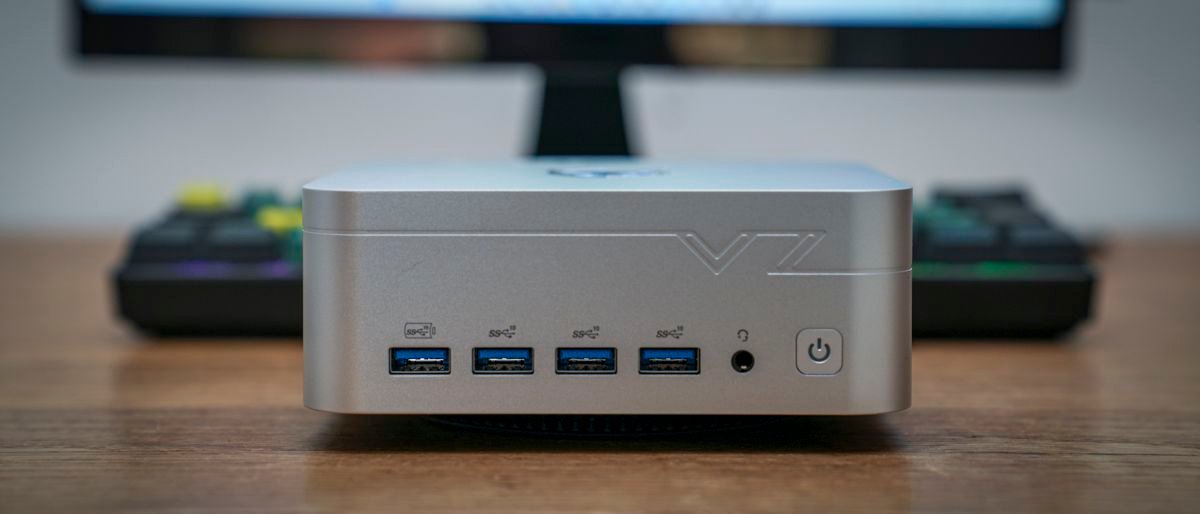
The AX9 Max instantly feels premium, with a full metal build and a huge array of ports on the front and back. However, as you look closely at the embossed detailing around the edges and a logo that seems to blend the old Cadillac and Ferrari logos, something about the aesthetics starts to looks a little less premium. Aesthetics aside, the build quality is solid enough and well finished, with the most impressive aspect being the sheer volume of ports that have been fitted around the exterior. On the front, there’s a selection of USB Type-A ports and the usual headphone jack; around the back, there are even more connectivity options, including two USB4 ports. To handle the potential power draw of the devices you can hook up to the box, it packs a powerful AMD Ryzen AI 9 HX 470 processor which is supplied with the 120W power supply. The processor is relatively new, launched at the start of 2026, so it has had a good amount of time to bed in and now has a proven track record. This is supported by an integrated GPU and a dedicated NPU for all those new AI workloads. As the test progressed, the machine’s speed in Microsoft Office apps and the Adobe Creative Suite highlighted its potential. During video editing, the internal SSD kept pace with high-resolution edits without issue. However, a little more headroom on the 1TB capacity would have been beneficial. Storage and RAM are the two interesting points of this machine. While both are modest in my review sample, maxing them out could turn this from a powerful mini PC into something that will hold great interest for anyone looking to run offline AI and larger LLMs, although that potential does come at a huge monetry cost. Throughout the test, the creative applications and handling of video and image files were limited by the 32GB of RAM and 1TB SSD. However, with two USB4 ports, I could at least boost the storage capacity. For most HD and 4K edits, the machine handled rough cuts and transitions in Premiere Pro quickly and without issue, though more RAM would have helped. The most interesting test was running LM Studio and a few local models; while general performance was good, especially for models that utilised the NPU, I could see where the 32GB RAM limit restricted what the machine could potentially do, limiting it as the best mini PC specifically for AI workloads. For gaming, at mid settings in most games like Cyberpunk 2077 and Indiana Jones and the Great Circle, the machine was more than capable of supplying the power needed for the action. However, again, a little more RAM would have smoothed some of the minor slowdowns in gameplay, especially in Cyberpunk 2077 where quality settings had to be lowered. This is a machine with potential, and while undoubtedly expensive for a mini PC with a 1TB SSD and 32GB RAM, that money is invested in that powerful CPU, GPU and NPU combo and the ability to expand the storage to a far greater degree than I have seen on the vast majority of other mini PCs of this size and type. VZMORE AX9 Max AI: Price and availability
How much does it cost? From $1,349
When is it out? Available now
Where can you get it? Directly from VZMore and online retailers. At present, the UK price is £1,349 for the 32GB RAM and 1TB SSD configuration I’m looking at in this review. At the time of review, the US site is down (maybe it’s just me?) , however, it’s available on Amazon for $1,399 . Value: 4 / 5
(Image credit: Alastair Jennings) VZMORE AX9 Max AI: Specs
Processor: AMD Ryzen AI 9 HX 470
Graphics: AMD Radeon 890M
NPU: AMD Ryzen AI, up to 55 TOPS
Memory: 32GB DDR5
Storage: 1TB PCIe 4. 0 SSD
Operating System: Windows 11 Pro
Front ports: 5 × USB 3. 2 Gen 2 Type-A, 3. 5mm Audio
Rear ports: 2 × USB4, USB 3. 2 Gen 2 Type-A, USB 2. 0 Type-A, 2 × HDMI 2. 1, 2 × 2. 5Gb Ethernet
Wireless: Wi-Fi 7, Bluetooth 5. 4
Card Reader: SD 4. 0
Power Modes: Silent 45W, Balanced 54W, Performance 65W
Dimensions: Approx. 134. 9 × 131. 8 × 57. 7mm
Weight: 777. 5g
Power Adapter: 120W
VZMORE AX9 Max AI: Design
Unpacking the compact AX9 Max, the metal casing and detailed plastic base of this mini PC instantly reinforced its price point. Only after carefully checking the detailing and the large, shiny logo on top did I start to question whether this was a premium machine or just one trying to look premium. Checking the specifications and that the price point was justified, but there’s still something about the design that feels a little over the top. The rest of the design is solid, and at 134. 9 × 131. 8 × 57. 7mm and 777. 5g, it’s a great size and weight for this style of machine. Around the casing, there are four USB 3. 2 Gen 2 Type-A ports and a 3. 5mm stereo headphone jack. On the left side of the casing is an SD 4. 0 memory card slot, while the back has two USB4 Type-C ports, a USB 2. 0 port, two HDMI 2. 1 ports, two 2. 5Gb RJ45 sockets, a USB 3. 2 Gen 2 Type-A port, and the DC-in port. (Image credit: Alastair Jennings) Despite the number of ports, they’re well laid out, and testing with multiple accessories, SSDs, and other card readers showed the port selection offered enough space to easily plug in and remove cables when needed. You access the inner workings of the mini PC through the base, and while it’s designed to be upgraded, initial access proved tricky, but only because of the four small rubber plugs covering the screw holes. Once these are removed, removing the base is easy, and thankfully there are no easily detachable wires to get in the way of speedy progress. Design: 4 / 5
(Image credit: Alastair Jennings) VZMORE AX9 Max AI: Features
The aesthetics of this machine are quite run-of-the-mill despite the premium metal build. However, as I checked the specifications, I found plenty that’s quite exciting. First, it features the AMD Ryzen AI 9 HX 470 with 12 cores and 24 threads, plus Radeon 890M integrated graphics. That’s a powerful combo, especially with the dedicated NPU rated at 55 TOPS. To keep up with this processing power, the machine has a substantial cooling system; flip it over, and the base design suddenly makes sense, as it, along with the huge venting on the back, is designed to keep the machine cool. VZMORE has its own cooling system called V-Cooling, which uses a vapour chamber and a 360º air intake on the base, and the company claims it provides 65W of sustained TDP output while keeping things quiet. In testing, this claim held up: the cooling seemed effective and quiet for the most part until it was put under heavy load and even then while the fans are audible they’re still well managed. As mini PCs go, one of the first notable features is the sheer volume of ports across the body. This is far more than most, with wireless connection options including Wi-Fi 7 and Bluetooth 5. 4. There are also three selectable power modes, including 45W Silent mode, 54W Balanced and 65W Performance. Through this test, I turned it to Performance mode. This machine is aimed at creatives, those looking to use AI and gamers- all high-demand applications. As I reviewed the specifications, a couple of points stood out. First, the internal SSD was limited to 1TB in the review sample, and given the machine’s price, I expected at least 2TB. The other point is that the SSD is PCIe Gen 4 x4, which still provides plenty of speed, as I saw in the benchmarks, but I would have expected an upgrade to PCIe Gen 5. The other point is that there are two M. 2 slots: one pre-installed with an M. 2 2280 module and one M. 2 2230, slot that can only take up to 1TB. That’s still 5TB in a relatively small box, but for this price, I would have expected a little more. the main point here is that CPU, GPU and NPU combo is an expensive choice and that’s what you’re paying for here. Then comes the real surprise, the RAM. This is 32GB of DDR5 SO-DIMM, split into dual-channel. That in itself isn’t unusual, but since AI is one of the machine’s key selling points, this 32GB can be upgraded to 256GB. However, at the time of writing, the most that I could find was 128GB in two 64GB modules for the cool price of £1,999. This could be possible, but would you really want it? In this test, I’ve run Qwen3. 6-35B-A3B and Gemma-4-26B-A4B through LM Studio…