Integrating Netflix’s Foundation Model into Personalization applications
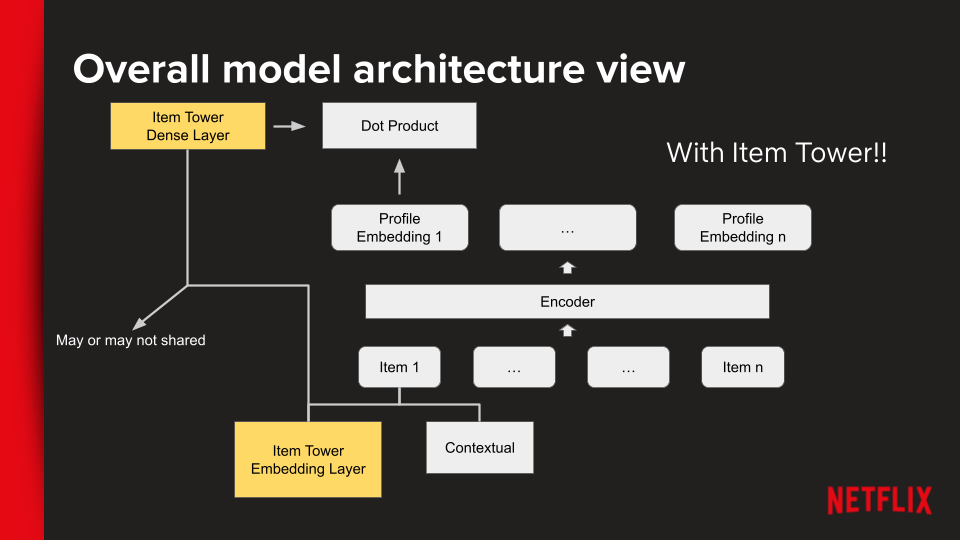
Authors: Divya Gadde , Ko-Jen Hsiao , Dhaval Patel and Moumita Bhattacharya The motivation for building the Netflix Foundation Model for personalization was laid out in this previous blog post. The Netflix homepage is powered by several specialized models and it requires significant time and resources to maintain and continue innovating on these individual models. Therefore, we decided to centralize member preference learning and have one powerful model learned from comprehensive user interaction histories and content data at a large scale and have this model distribute its learnings to other models. The previous two blog posts( 1 , 2 ) focus on the development of the Foundation Model and here we talk about how we integrate the Foundation Model into various applications. We found that there is extensive literature focused on the training and inference of large-scale transformer-based models. However, there remains a significant gap in practical guidance and research on how to effectively and efficiently integrate large models into existing production systems. At Netflix, we experimented with 3 distinct integration approaches — embeddings, subgraph and fine-tuning. The motivation for trying different approaches stems from varying application needs. Specifically, different teams have different latency requirements, tech stack constraints and different appetites for leveraging the full power of a large foundation model. In this blog, we go over the 3 approaches we experimented with and which are now used in production for different use cases. Each integration approach has its own set of motivations, tradeoffs, complexities and learnings. The following sections go into the details of each of these integration approaches. Embeddings from Foundation model Transformer style foundation models naturally lend themselves to generating comprehensive user profile and item representations. Our approach for generating embeddings includes getting the hidden state of the last user event as the profile embedding and weights from the item tower as item embeddings. Netflix has an elaborate set up for refreshing the embeddings every day. First, the Foundation Model is pre-trained from scratch every month. Then, the monthly pre-trained model is fine-tuned everyday based on the latest data. The daily fine-tuning also expands the entity id space to include the newly launching titles. After the daily fine-tuned model is ready, we run batch inference to refresh the profile and item embeddings and publish them to the Embedding Store. An important part of this setup is the embedding stabilization technique ( paper ). When the pretraining job retrains the model from scratch, the embedding spaces between different runs are completely different due to the random initialization in the model. In addition, the embeddings start to drift when the daily job fine-tunes on the latest data, despite the daily fine-tuning job warm-starting from the previous day’s model. Therefore, it is important to map the embeddings generated everyday into the same embedding space, so that downstream models can consume pre-computed embeddings as features. This embedding approach relies heavily on the Embedding Store, which is a feature store specializing in embeddings built by the platform team at Netflix. The embedding store makes producing and consuming embeddings easy by taking care of versioning and timestamping the embeddings. The Embedding Store also provides various interfaces to access the embeddings offline and online. Embedding Store integration This approach is often the initial and most straightforward way for applications to interact with the Foundation Model. Embeddings can serve as powerful features for other models or for candidate generation, helping to retrieve appealing titles for a user or facilitate title-to-title recommendations. Integrating embeddings as features into existing pipelines is generally well-supported and offers a low barrier to entry. Compared to other integration approaches, using embeddings from the Embedding Store is expected to have a relatively smaller impact on training and inference costs. However, this approach also has some cons. The time gap between embedding computation and downstream model inference can lead to staleness, impacting the freshness of recommendations. This may prevent applications from fully unlocking the benefit of the Foundation Model, especially for use cases requiring real-time adaptability. Overall, the default starting point for leveraging the Foundation Model is through its profile and item embeddings via the Embedding Store, provided that the embeddings’ freshness and stability meet application-specific needs. While embeddings may not leverage the full power of the Foundation Model, they offer a good initial step. Our biggest learning from working on this approach is that embeddings are a low cost and high leverage way of using the Foundation Model. A resilient embedding generation framework and embedding store are essential for updating the embeddings daily and serving them to application models. We found this infrastructure to be so valuable that we stepped up our investment here to build a near-realtime embedding generation framework. This new framework also enables us to update the embeddings based on user actions during the session, making the embeddings and our downstream models more adaptive…