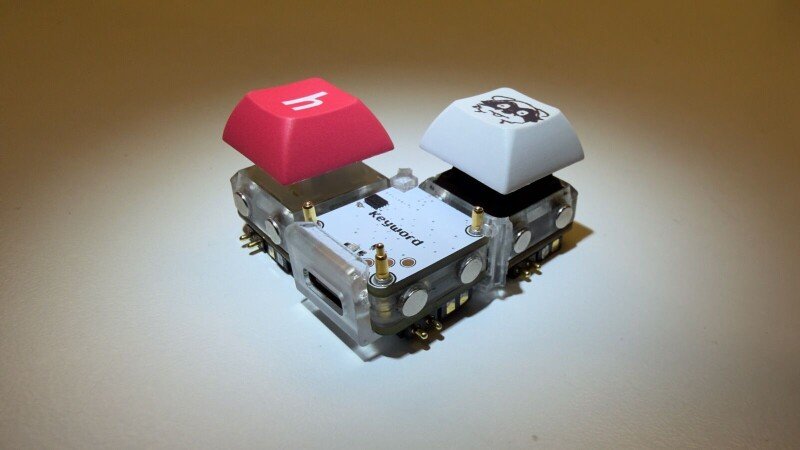
Open source keyboard lets you swap parts like magnetic Legos
The world is full of different keyboard layouts, but if you want one that’s completely customized, down to the individual key, there’s a new open source project that uses magnets to hold interchangeable pieces together. Keybytes is an open source project that allows any ambitious builder to create a fully modular keyboard – and we’re talking FULLY modular here. Each key contains its own RISC-V microcontroller and pogo pins on all four sides, providing power and I2C connections between adjacent modules so users can rearrange the keys into different layouts. The only extra component needed is a controller module, which coordinates the individual keys and handles communication with the host computer. And good news: Despite consisting of two stacked circuit boards, it has the same footprint as the single-key modules that attach to it. The entire thing was designed by a Massachusetts Institute of Technology freshman named Nathan Alspaugh, who is studying aerospace engineering. Alspaugh has always wanted to design his own keyboard, and who better than an MIT student to go over the top in building the most intricate, overengineered version imaginable? “I had always wanted to make a keyboard but I didn’t want to be locked into just one design so I wanna make it so that I can rearrange it at any time,” Alspaugh said in the first entry of his project journal , which he’s been keeping since March of this year. “I searched online and couldn’t find it anywhere so I decided to make it myself.” The main readme in the GitHub project isn’t super detailed, instead mostly describing what the project entails for anyone willing to give it a shot (custom printed circuit boards, Cherry MX switches, 3D-printed cases, and a whole lot of tiny soldered components). It’s Alspaugh’s journal where the depth of the work he did is laid bare for all to see, and boy did he do a lot of work…