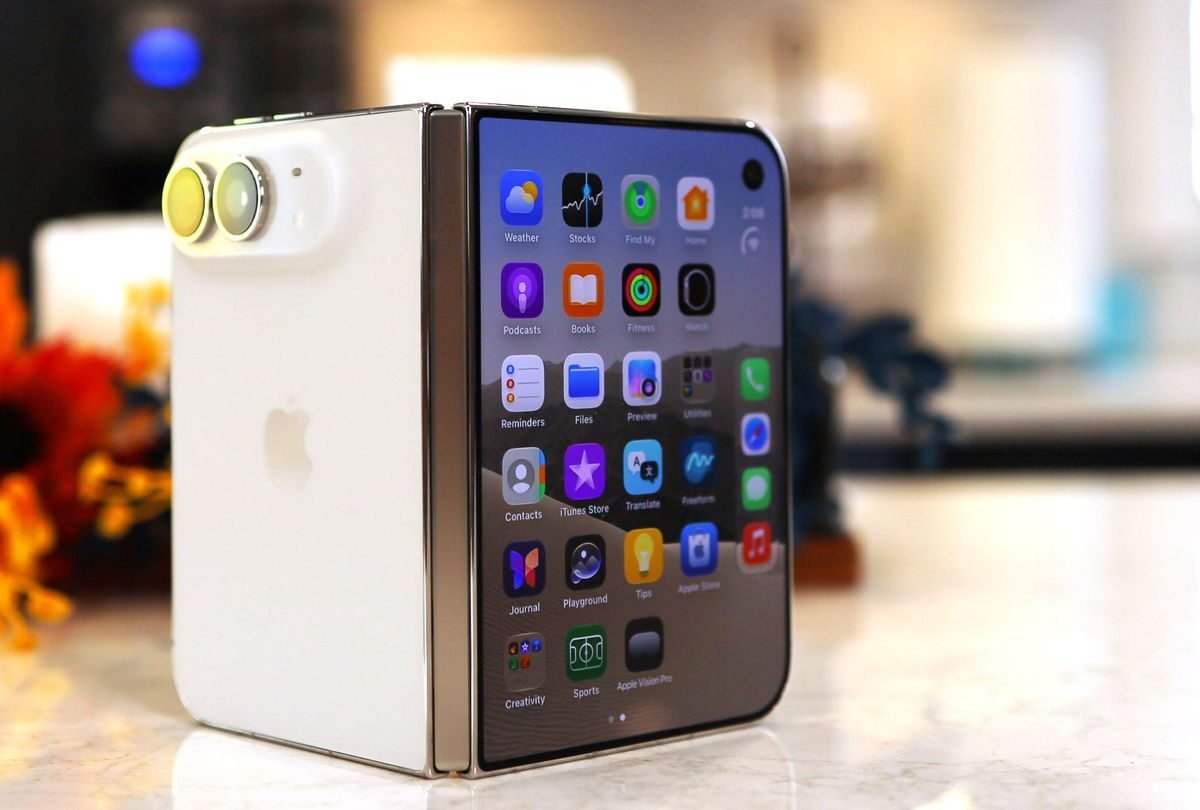
Apple iPhone Duo: Two-minute review
In the early days of the iPhone, seeing one in the wild, usually in a brave early adopter’s hands, was like spotting a unicorn. The excitement was palpable. Over the years, though, as every smartphone has become a glass and metal slab, making it difficult to tell one iPhone release from another, the excitement has diminished. Where I used to keep my ‘regular’ iPhone review units out of sight, I now casually carry them around in a case, and no one is any the wiser. That, though, is not the case with the iPhone Duo. In my effort to spend as much time using the new folding iPhone as possible, I carried it everywhere, including to a wedding party for my friend’s son. My iPhone Duo test unit was somewhat disguised by being clad in a Taupe Folio with a Kickstand case, but as I held it aloft to photograph the newlyweds, the bride’s eyes grew wide. "Is that…?!" My eyes darted from her to the phone in my hand, and I considered stuffing it back in my pocket, but I was intrigued by her reaction. I hadn’t seen this level of interest and excitement in years. I nodded wordlessly; the newlyweds started peppering me with questions, and as I folded and unfolded it, and they glimpsed the inner display, the bride’s jaw dropped. She asked if I liked it. I mumbled, "Yes, I think so," without offering much more information. I was determined to use the iPhone Duo’s two external 48MP cameras to photograph the event, which meant this scenario repeated itself more than once. It was obvious that, unlike every other iPhone of the last decade or so, the iPhone Duo could not travel incognito; people were, it seemed, intensely interested in Apple’s first truly new iPhone form factor in basically forever. The interest is warranted. (Image credit: Lance Ulanoff / Future) The iPhone Duo is not simply an iPhone folded in half. I’d argue it’s only marginally an iPhone and more of a hybrid, splitting the difference between a sub-sized smartphone and a slightly larger, 8-inch iPad mini. From the highly polished titanium frame to the curves and pitch-perfect tolerances, the iPhone Duo’s design is Apple at its best, and while it doesn’t reinvent the genre, the nano-texture finish on the main display cannily solved the chief folding phone complaint: that darn crease. It’s not that the crease is completely gone, but in daily use it’s virtually invisible. As an added bonus, that matte finish kills reflectivity in bright sunlight, and makes almost everything look better. Apple includes four cameras, three of which are powerful enough to produce high-quality photos across a range of styles. I saw excellent color accuracy and low-light performance, and the ultra-wide camera feels expansive. The inner-display camera is, it appears, just 4MP, but it does a good job with casual selfies and FaceTime calls. Apple has almost stuck the landing here, but there is a slight step backwards. I’m fairly certain its decision to move the status bar and dock to the right side of the 5. 4-inch outer screen, and therefore shrink the width of most apps, will divide opinion. I like how this makes it easy to tap an app with your right thumb, but the remaining screen real estate makes some app experiences look and feel cramped. Then there’s the lack of Face ID on the cover screen, which means this is the first iPhone in ages that I have to use my finger to unlock. I’m also less than thrilled that a nearly $2,000 / £1,999 phone starts with just 256GB of storage; although, to be fair to Apple, the $1,899. 99 / £1,699 Galaxy Z Fold 8 also starts with the same amount. Those small nits are like pointing out the missing eyelashes on the Mona Lisa, though. Overall, this is a fantastic entry into the folding phone space, offering the dual capabilities of a glanceable and attractive iPhone that fits in any pocket or hand, and a versatile 7. 6-inch tablet. Not everyone needs two screens in one device, or wants to pay as much as they would for a home appliance for their next smartphone; but for those who feel confined by the boundaries of a typical iPhone and want to do more in less space, the iPhone Duo, which starts out smaller than your average smartphone but unfolds to reveal an almost twice-as-large tablet display, is well worth your consideration. Apple iPhone Duo review: Price and availability
From $1,999 in the US
From £1,999 in the UK
From $3,499 in Australia
Apple unveiled the iPhone Duo, its first folding phone, as its "one more thing" during the Surprise and Shine event on September 9, 2026. The list price is $1,999 / £1,999 / AU$3,499 for the 256GB model, which is in line with most of its folding competitors from Samsung, Huawei, Motorola, and Oppo. It’s available in storage configurations up to 2TB for $3,199 / £3,199 / AU$5,899. The iPhone Duo is the most expensive iPhone Apple has ever made, but we should put this in context. Like most foldables, this is a two-in-one device: a pint-sized smartphone with a 5. 4-inch 4:3 screen, and a 7. 6-inch tablet. Unlike the Galaxy Z Fold 8, which has a similar passport-style shape, and even the Samsung Galaxy Z Fold 8 Ultra, which is a more conventionally sized and shaped foldable, the iPhone Duo’s larger main screen supports digital pen input (this wasn’t available for my testing period, but it’s expected by November). You may also be able to soften the price blow a bit with a trade-in; or you might want to look at Apple’s leasing program, which will run about $57-to-$83 / £47 to £66. 63 / AU$97. 19 to over $161 a month for the base model. In total, the iPhone Duo is probably better value than you think. Apple iPhone Duo pricing Storage
US price
UK price
AU price
256GB
$1,999. 99
£1,999
AU$3,499
512GB
$2,199
£TBD
AU$TBD
1TB
$2,599
£TBD
AU$TBD
2TB
$3,199
£TBD
AU$TBD
Value score: 4 / 5
Apple iPhone Duo review: Specs
These are the key specs of the Apple iPhone Duo:
Dimensions:
Unfolded: 164. 6 x 117. 8 x 5. 2mm, Folded: 84. 1 x 117. 8 x 11. 3mm
Weight:
254g
Displays:
Main: 7. 6-inch Super Retina XDR, Cover: 5. 4-inch Super Retina XDR
Resolution:
Main: 1878 x 2670, Cover: 1398 x 2034
Refresh rate:
1-120Hz (main and cover)
Peak brightness:
3,000 nits
CPU:
A20 Pro
RAM:
12GB
Storage:
256GB, 512GB, 1TB, 2TB
OS:
iOS 27
Cameras:
48MP wide (f/1. 6), 48MP ultra-wide (f/2. 2)
Selfie cameras:
11MP Center Stage camera (f/2. 2) outer, 4MP (f/1. 8) inner
Battery:
4,800mAh (approximate)
Charging:
60W wired, 35W wireless
Colors:
Star White, Night sky
Apple iPhone Duo review: Design
Polished titanium
Exquisitely engineered hinge and folding operation
Unfolds flat
IP68
Thicker and heavier than nearest competition
No Face ID
‘Satisfying’ is the best way to describe the feeling of repeatedly opening and closing the iPhone Duo. It’s as if Apple inadvertently created a digital fidget spinner — the more I carried around the iPhone Duo, the more I found myself absentmindedly folding and unfolding the phone. Apple’s exceptional engineering makes it possible to unfold the phone initially, with almost no effort (it almost springs open at the slightest intentional touch), before the internal torque kicks in to allow for the Duo to be opened to almost any angle between zero and 180 degrees (flat). Lance Ulanoff / Future Lance Ulanoff / Future Lance Ulanoff / Future Lance Ulanoff / Future While you can’t see the work that went into making this hinge, the effort is evident in every single touch and move. Inside are hundreds of magnets and other components that keep the phone securely closed, but never get in the way of an easy opening. More so than with any folding phone I’ve tested, the hinge essentially disappears when the iPhone Duo is unfolded flat. At 5. 2mm thick, the fingerprint-attracting polished titanium iPhone Duo is the thinnest iPhone ever. At least that’s how Apple markets it, but that’s in tablet mode; I do like the sound of a 5. 2mm-thick tablet. The 7. 6-inch device is thinner than the 8-inch iPad mini (6. 3mm). Folded, the iPhone Duo is 11. 3mm thick, almost 2mm thicker than the folded Galaxy Z Fold 8. And at 254g, the iPhone Duo outweighs the Galaxy Z Fold 8 by a noticeable 53 grams. It’s even slightly heavier than the iPhone 18 Pro Max, which weighs 249g. Lance Ulanoff / Future Lance Ulanoff / Future Lance Ulanoff / Future Lance Ulanoff / Future Lance Ulanoff / Future Lance Ulanoff / Future Lance Ulanoff / Future The upshot of all this is that while the 4. 64-inch by 3. 31-inch folded iPhone Duo fits in even the smallest pocket, you will feel its heft, especially if you pop, say, a Folio with Kickstand case on it. The iPhone Duo stands out in a way few iPhones have in recent years. Folded, it’s closer to square than rectangular in shape, resembling a squat iPhone Pro Max. Plus, the asymmetry — flat and square on one side and curved on the other when folded — means the Duo cuts a unique profile among smartphones. It does feel good in the hand, though the wider body might take some getting used to. I like the Ceramic Shield 2 front and back, especially the matte-finished back, which makes the Duo almost slip-from-your-hand-proof. The large dual-camera array bump is reminiscent of the iPhone Air, though the similarities end there. (Image credit: Lance Ulanoff / Future) The volume buttons live on the top edge, another departure from the traditional iPhone, and indeed from smartphone design in general — I’m not sure I love that decision. On the right is the long Touch ID-enabled power/sleep/Siri AI button, and below that is the Action button. I often forget that last button exists on my iPhone 18 Pro Max, and I wonder if it was truly necessary here. I appreciate the inclusion of Touch ID (I registered my index finger and thumb), but the lack of Face ID is frustrating — I had no idea how much I relied on it for quickly unlocking my phone until it wasn’t there. Multiple times I’ve stared at the iPhone Duo’s cover screen waiting for something to happen, forgetting that I have to intentionally touch the Touch ID button. A nearly $2,000 device lacking Apple’s most powerful biometric security feature is close to unforgivable — I’ll probably set up a workaround so that I can unlock the Duo via my Apple Watch. Samsung Galaxy Z Fold 8 on left, iPhone Duo on right Lance Ulanoff / Future Samsung Galaxy Z Fold 8 on left, iPhone Duo on right Lance Ulanoff / Future Samsung Galaxy Z Fold 8 on left, iPhone Duo on right Lance Ulanoff / Future Samsung Galaxy Z Fold 8 on left, iPhone Duo on right Lance Ulanoff / Future Samsung Galaxy Z Fold 8 on bottom, iPhone Duo on top Lance Ulanoff / Future Samsung Galaxy Z Fold 8 on left, iPhone Duo on right Lance Ulanoff / Future Along the bottom edge are the USB-C port (the phone ships with a charging cable but no power adapter), the speakers, and the mics. Unfolded, the iPhone duo feels like a thin, compact tablet — I hesitate to say ‘iPad’ since the operating system is essentially iOS with some small adjustments for the new form factor. Lance Ulanoff / Future Remarkably, Apple comes out of the folding gate flourishing an IP68 rating, which means the iPhone Duo is protected against dust and even water. Naturally, I submerged the Duo under a running faucet, and it was none the worse for the experience. Overall, I like the design and form factor, but it’s different from a traditional iPhone, so it does take some getting used to. I struggled, for instance, to figure out the best way to hold the phone for photography. Do I need to turn it into landscape mode, or should I just hold it the way I hold a ‘regular’ iPhone? I do wonder how many will choose to unfold the phone, and shoot pictures in the same way they might with their iPad. Design score: 4. 5 / 5
Apple iPhone Duo review: Displays
(Image credit: Lance Ulanoff / Future) Adorable and unusually shaped 5. 4-inch cover display
Industry-leading 7. 6-inch foldable internal display
Crease is canily hidden via a combination of expert engineering and a nano-etched display
Bright, sharp, fluid screens
Credit to Apple for not skimping on either of its iPhone Duo displays. Both the 5. 4-inch outer and the 7. 6-inch flexible inner screens are Super Retina XDR-class OLED panels, both with variable refresh rates up to 120Hz, always-on functionality, and up to 3,000 nits of brightness. Both displays look impressively sharp, and actually offer slightly higher resolutions than the comparable displays on the Samsung Galaxy Z Fold 8. The iPhone Duo’s 5. 4-inch cover display has a 2034 x 1398 resolution (compared to the Galaxy Z Fold 8 cover display’s 1972 x 1248), and the 7. 6-inch Inner display is 2670 x 1878 (compared to the Z Fold 8’s 2448 x 1848 main display). At first glance, the iPhone duo Cover screen is instantly recognizable as an iPhone, but close scrutiny reveals some interesting adjustments for the relatively short and wide display. First, the pill-shaped Dynamic Island sits in a vertical space along the right side, and when you look at the home screen, the dock is stacked vertically below the time and a status button (a single tap on it expands it to show connectivity and battery, and also drops down the full Control Center). The Duo takes that right-hand space and rarely gives it up, which means that websites can look cramped in Safari, and some apps like TikTok, and even Apple’s native ones, like Sports, can feel a bit squeezed. There are exceptions, like when you use the screen as a viewfinder in the Camera app, or look back at images in the Photo Gallery. In those cases, the imagery fills the entire screen. (Image credit: Lance Ulanoff / Future) I’m less conflicted about the glorious main screen. It’s big, it’s responsive, and the matte, nano-texture covering almost completely hides the crease by dispersing any light bouncing off it, instead of directing it right back to your eyes. The display looks and feels perfectly flat, plus that matte covering kills all reflections, and makes every image look almost magazine-quality. It could be argued that a tiny bit of visual punch is lost in the texture, but I really enjoyed everything I viewed and did on the screen. It feels wonderful to the touch, and I had fun playing games like PUBG , browsing the web on a big screen, watching Netflix, reviewing and editing my photos, and multi-taking (more on that later). Unlike the Galaxy Z Fold 8 and 8 Ultra, the iPhone Duo’s inner display supports a stylus, specifically the USB-C Apple Pencil. That support is not yet live, but I can’t wait to start drawing on the Duo. I did attempt some Procreate Pocket sketches with my finger, and it didn’t go well, which is mostly a me problem. However, I had slightly better luck with an analog stylus (see below). (Image credit: Lance Ulanoff / Future) Apple hides the 4MP inner FaceTime camera behind a handful of pixels, but they don’t appear to have the exact same mix of matte and pixel density as the rest of the display, and as such are easy to spot. I wonder if Apple should have just gone with a standard, albeit smaller, cutout. As on the cover display, Apple has positioned the status and dock vertically on the right side of the main display. I wonder why, in Tablet mode, Apple didn’t simply copy the iPad and put this bar at the base of the screen. Still, I noticed that the dock disappears when you’re in apps like Safari. There’s more to say about app compatibility with this platform, which I’ll get into later in the Software section of this review. (Image credit: Lance Ulanoff / Future) I especially like the redesigned Standby feature, which takes advantage of the Duo’s multiple displays and foldable nature. You can prop up the phone like a tent and have the Standby display appear in landscape mode. If you flip the phone up so it’s standing on your desk like an open book, the Duo knows to switch Standby to the inner display. At one point I popped the Duo onto my old Belkin MagSafe charger, and used it as a nightstand clock. It’s so smart and useful. What we have here are two excellent displays with a wide array of capabilities in one device. It’s both a tiny iPhone and a mini tablet, with two screens that should please both the iPhone and iPad crowds. I have my reservations about the cover screen, but as an overall multi-display package, I’m impressed with the Duo. Display score: 4. 5 / 5
Apple iPhone Duo review: Cameras
Two strong 48MP cameras
Excellent 12MP Center Stage camera
Inner camera is lower-resolution but effective for FaceTime
No telephoto camera
It’s been a long time since I’ve reviewed an iPhone on which camera considerations come second to design and mechanical engineering, but the excitement revolving around the iPhone Duo is about its folding capability, creaseless inner screen, and unique-among-iPhones form factor. Even so, there’s no indication that Apple has skimped on three of the four cameras. Yes, the inner camera is just a 4MP shooter that’s primarily devoted to FaceTime calls, but the rest of the lenses — 48MP f/1. 6 Main, 48MP f/2. 2 ultra-wide, and 12MP f/2. 2 Center Stage — are all excellent. While I haven’t had a lot of time with the iPhone Duo, I have managed to shoot in a variety of conditions and situations, pushing the cameras on speed, image quality, color, and low-light performance. The two external cameras default to shooting at 24MP, which means each photo has effectively twice as much information per pixel (the process is called binning). (Image credit: Lance Ulanoff / Future) I was particularly impressed by the level of detail in the main-camera shots — just look at the specks of pollen on the marigold flower in the gallery below…